
Dental Practice Valuation: How Much Is Your Practice Really Worth?
Updated: Sep 1
By Spiro Leunes, CPA | CEO, MRL Advisory Group, New Jersey and New York Dental CPAs
Ask ten dentists what their practice is worth and most of them land on the same answer. Somewhere around 70 to 80 percent of collections. That rule has been floating around study clubs for decades, and it still gets repeated at every dinner meeting. The trouble is that it answers a question buyers stopped asking a long time ago.
Two offices that both collect $1.5 million can sell for numbers that are hundreds of thousands of dollars apart. I have seen it happen more than once. If you are anywhere within ten years of a transition, this is worth understanding, because it is your money we are talking about.
So let me walk through how practices actually get priced now, why two buyers will look at the same practice and offer you very different amounts, and what you can do between now and your sale to push the number up.
The Old Math: Percentage of Collections
The percentage of collections method has not disappeared. You still see it in doctor to doctor deals. A general practice might change hands somewhere between 60 and 85 percent of a year's collections, and where you land in that range depends on location, payer mix, the shape the office is in, and how well the patient base transfers to a new owner.
It is an easy method to explain, and that is most of its appeal. It is also close to useless, because collections say nothing about profit. Take two practices that each collect $1.5 million. One runs at 75 percent overhead and the other at 58 percent. The first one leaves the owner about $375,000 before any doctor compensation. The second leaves more than $600,000. Those are not the same business, and pricing them off the same percentage is how a seller gives money away and how a buyer overpays.
Collections based pricing hangs on because you can explain it over lunch in thirty seconds. No serious buyer values your practice that way anymore.
The New Math: What the Practice Actually Earns
DSOs, private equity backed groups, and these days plenty of individual buyers who have good advisors, all price on earnings instead of collections. What they want to know is how much money the practice really produces once every bill is paid. The catch is that earnings are not one fixed number. Which version applies to you depends on how big your practice is and who is sitting across the table.
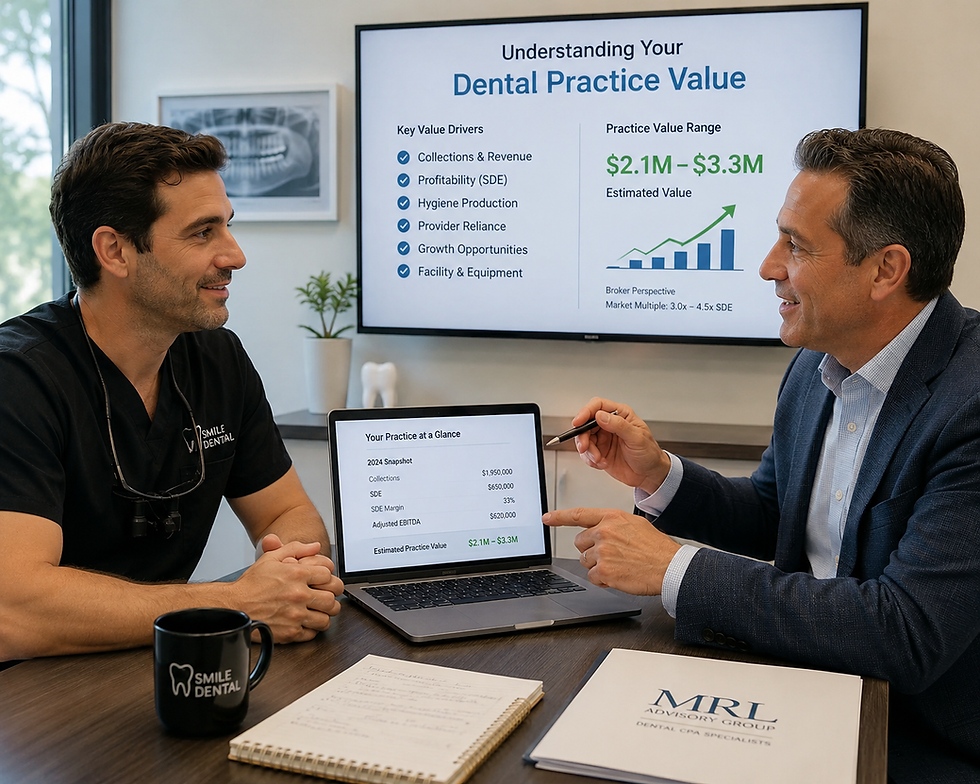
If you own a solo practice and you are the one producing, the number that matters is your Seller's Discretionary Earnings, or SDE. Think of SDE as everything a single owner pulls out of the practice in a year. Net profit, the salary you pay yourself, the personal costs that run through the business, and the non cash and one time items like depreciation and interest all go back in. Put simply, if one dentist owned this place and worked in it, what would actually land in their pocket at the end of the year? For a solo practice that is the number that tells the truth, because whoever buys it is going to sit in your chair and do the work you were doing.
That is the reason SDE, and not EBITDA, is the right yardstick for a solo practice. Your buyer is not going out to hire a dentist to take your place. Your buyer is that dentist. The paycheck you were writing yourself does not come out of the math. It goes home with them, so it stays in the number.
Now picture a bigger practice, one with a few doctors and real associate production, the kind a DSO or a group wants to buy. There the yardstick changes to EBITDA, earnings before interest, taxes, depreciation, and amortization, with one adjustment that catches people off guard. A group has to pay somebody to produce your dentistry once you are gone. So before they count a dollar of profit, they take out a fair market salary for the dentist who replaces you. Say the practice throws off $500,000 of total owner benefit. That is your SDE. If it costs $300,000 in associate pay to cover your production, the EBITDA the DSO is looking at is closer to $200,000.
Same practice, two very different figures. It comes down to whether the buyer gets to keep your salary because they are working the chairs, or has to spend it because they are hiring the person who will. That single adjustment is usually where a seller's expectations run into a wall. You have spent your whole career treating that half million as what the practice earns. The DSO treats it as what the practice earns after it pays the associate it now has to bring in.
Once the earnings number is settled, somebody applies a multiple, and this is where I watch owners get tripped up, so I want to be plain about it. An SDE multiple and an EBITDA multiple are not interchangeable. SDE is the bigger number because your salary is still inside it, so it carries a smaller multiple. EBITDA is the leaner number and carries a bigger one. A practice quoted at three times SDE and the same practice quoted at six times EBITDA can be the identical price. If somebody hands you a multiple, your first question should be what it is a multiple of. Otherwise you are comparing nothing to nothing.
Why the DSO and the Young Dentist Down the Street Offer Different Prices
The same practice really can be worth different amounts to different buyers, and it is not because one of them is wrong. They are buying two different things and measuring with two different rulers.
The young dentist buying your practice is buying a job and an asset at the same time, so the offer follows your SDE. There is no replacement dentist to pay, because the buyer is the replacement. Every dollar you were paying yourself is now available to the new owner, and that is a dollar they can put toward the deal. What holds them back is the bank. A lender is going to size the loan against cash flow that has to cover the note, the buyer's own living expenses, and still leave a little breathing room. That ceiling is real, and it does not bend much.
The DSO or group is buying earnings it can drop into a much larger operation, so its offer follows EBITDA. It is going to staff your chair, which means your salary comes out before anybody counts profit. In exchange it brings things you cannot get on your own, like better pricing on supplies, a central billing operation, and more weight at the table when it negotiates with the PPOs. The headline offer is often bigger. Read the fine print before you celebrate. Some of that number can show up as equity in the parent company, some as an earnout that depends on how the practice performs after closing, and some can be tied to you staying on and producing for three to five years at an agreed salary. A bigger number wrapped in conditions is not automatically a better deal, though now and then it genuinely is. The only way to find out is to lay both offers side by side and run them all the way down to what you actually keep after taxes and obligations. That is the kind of acquisition advisory work we do with clients before they sign anything.
The Factors Baked Into Your Practice
Part of your multiple is set before you make a single move. It comes from the type of practice you own and the ground it sits on. You are not going to change these overnight, but you should know where they leave you before an offer ever lands on your desk.
Specialty. Specialty practices, orthodontics, oral surgery, pediatric dentistry, periodontics, prosthodontics, usually sell for a higher multiple than a general office. The margins tend to be stronger, the referral base is harder for a newcomer to pry away, and you cannot replicate a specialist's production by opening a general office across the street. Buyers know that, and they pay up for it. None of this makes a general practice a bad buy. It just starts the conversation from a different place. And if you are a general dentist weighing whether to build a specialty into your own office, that is its own financial decision worth running the numbers on.
Fee for service versus PPO. A fee for service practice will almost always carry a fatter margin than one built on PPO and other insurance based reimbursement, and the reason is not complicated. You are collecting your full fee instead of a discounted one somebody else set. Fatter margins mean more earnings on the same collections, and earnings are the thing being priced. Lean too hard on the worst paying plans and you hold down both the margin and the multiple, partly because the buyer is also bracing for the next round of reimbursement cuts nobody can control. That cuts both ways once a buyer is at the table. The margin on the page was earned at the seller's reimbursement rates, and whether those rates transfer to a new owner is a separate question worth settling before the price is.
Location and demographics. The neighborhood matters as much as the production. A buyer is looking at where the population is growing, what households earn, how old the community skews, how many competitors sit within a few miles, and whether an associate can even be recruited into that market. A strong practice in a growing, well off, under served area is simply a different asset than the very same practice sitting in a town that is shrinking or already crowded with offices.
What You Can Actually Do to Move Your Number
Everything above sets your floor. From there the number is not locked. It moves with the choices you are making right now, and these are the ones that move it the most.
Overhead discipline. A dollar of waste you cut out of overhead is not worth a dollar to you. At a multiple it is worth several dollars on the day you sell. Tightening up your profit leaks two or three years ahead of a sale is about the best return on effort you will find in this business.
Provider dependence. When you walk out and every bit of production walks out with you, the buyer marks the price down, and they are right to. This is a bigger lever than most owners realize. As you build associate production and get systems running without you standing over them, you start to move the practice out of solo SDE territory and toward being valued like a group on EBITDA, which is a different measure and a higher multiple both. The practice with associate production, a full hygiene schedule, and systems that do not lean on the owner is the one that earns the premium.
Clean books. Almost every dental practice keeps its books on a cash basis, and there is nothing wrong with that. No buyer expects accrual accounting from a dental office. You cannot responsibly book insurance receivables when you have no idea what a carrier will actually pay until the EOB shows up. What a buyer does expect is cash basis books that are clean and consistent, with expenses in the right categories, owner perks written down where anyone can see them, and monthly numbers that reconcile. This matters even more on an SDE valuation, because the whole exercise depends on cleanly proving every legitimate add back. When personal spending is buried all through the P&L, a buyer starts to doubt every figure on the page, and a buyer who doubts you pays you less. If someone has to go digging to find your real earnings, you are paying for the buyer's discount out of your own pocket. Keeping cash basis books clean and consistent month to month is exactly what solid accounting services are for, and that discipline quietly pays for itself the day you sell.
Payer mix and fee position. You cannot change your specialty, and you cannot pick up the building and move it, but your payer mix has more give in it than owners think. Drop the worst paying plans, push to renegotiate the ones you keep, and steer the practice toward fee for service over a few years, and your margin climbs, which pulls your earnings and your multiple up with it. It is the fee for service advantage from earlier, except now it is a project you can actually run.
Trend line. A practice putting up 5 to 8 percent growth a year is worth more than a flat one earning the same money today, and it is not close. Buyers are paying for where the practice is headed, not where it has been.
Owning the building. Owning the building your practice occupies also changes the picture at sale. See our guide on buying versus leasing a dental office in New York City, the NY metro, and New Jersey.
The Mistake I See Most Often
Owners put off finding out what the practice is worth until the day they feel ready to sell. By then the levers I just described need years to work, and the years are gone. The same goes for the succession plan itself, since the one you sketched out years ago may not fit the associate you have across the hall today. The people who exit well treat their valuation as a number they check regularly, right next to the tax plan, not something they meet for the first time when a DSO letter lands in the mailbox.
And the letters do come. When one shows up, keep in mind that an unsolicited offer is a number set for the buyer's benefit, not yours. It is a starting line, nothing more.
The Bottom Line
Two years out or fifteen, the quality of the earnings you build now is what sets the size of the check later. Far better to know your number while there is still time to do something about it than to hear it for the first time from the person trying to buy you.
At MRL Advisory Group we work with practice owners across New Jersey and New York to pin down their real SDE and EBITDA, whichever one the likely buyer is going to use, measure it against what practices are actually selling for, and put together the two to five year plan that gets the number as high as it will go before anyone signs.
If you have never sat down for a real valuation conversation, or the last one you had was some percentage of collections scratched out on a napkin, reach out and set up a free consultation. It is a far better thing to know your number while you still have room to improve it.


Comments