
Selling a Dental Practice: How Succession Has Changed
Updated: Jul 31

By Spiro Leunes, CPA | CEO, MRL Advisory Group – New Jersey and New York Dental CPAs
Succession planning is different today than a generation ago. For practice owners in the latter stages of their careers, understanding those shifts and planning accordingly can make a significant difference in who they sell to and the final outcome.
Traditional practice succession had a familiar path. The physician or dentist built a practice, brought on an associate, and the associate bought the practice. If there was no associate to transition the practice to, there was typically a willing buyer for the practice. Though traditional, both paths exist, but it is no longer a given.
The average practice owner is getting older, with a large portion of dentists and physicians retiring over the next 10 – 15 years. Simultaneously, younger physicians and dentists are graduating with significant debt and different professional priorities. Today’s clinicians want flexibility and consistent income without the administrative burdens or practice ownership.
Understanding Today’s Buyers
DSOs and MSOs and private equity backed groups are active buyers in the dental and physician marketplaces. They evaluate practices differently than an associate, or single clinician buyer.
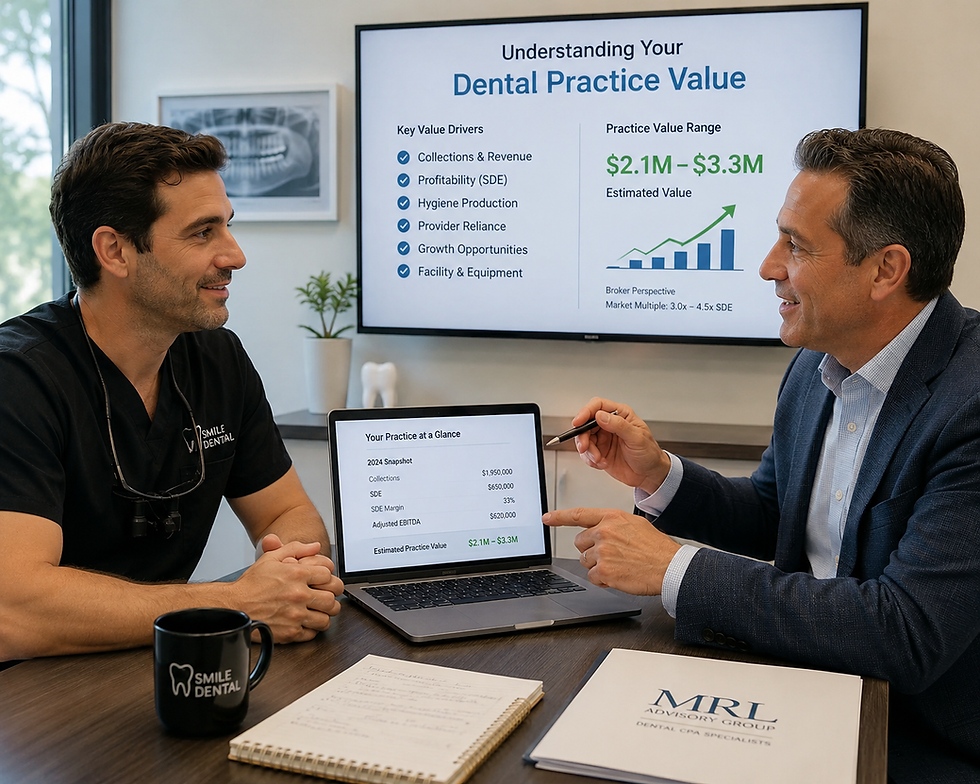
They focus on financials, EBITDA, revenue concentration, payer mix, provider dependency and transferable systems with documented processes and procedures. Well organized, financially consistent practices attract stronger interest, better terms for the clinician and higher multiples. Practices that are heavily owner-dependent, have inconsistent records without well documented procedures and systems are harder transitions despite clinical reputation. Value and transferable value are not always the same number. That gap between value and transferable value is worth sitting with, and I go deeper into how the final number gets set, and why the same practice can be worth very different amounts to different buyers, in how much your practice is really worth.
Internal Succession Takes More Planning
Internal transitions are more complicated today for many reasons:
Student debt – Many new dentists and physicians have substantial student debt. Taking on additional debt to acquire a practice requires careful planning and structuring. Banks have now increased the terms of their loans to 10 and 15 years so practices for cashflow better for the buyer.
Lifestyle priorities – Younger clinicians prefer to focus on patient care, rather than the administrative burden of practice ownership. This doesn’t mean that today’s clinicians will never own. They often desire a clearer path to ownership and for the path to be clearly defined.
Evolving Risk Appetite – After the 2008 financial crisis, COVID era shutdowns, and student debt, today’s clinicians are much more cautious before making a major financial commitment.
Internal succession can still work well, but agreements must be clearer, with structured timelines, and defined incentives rather than an informally promised “someday” for practice ownership.
What Buyers Are Looking For
Whether transitioning internally, selling to an independent clinician, DSO or MSO, today’s buyers and investors are more discerning. They are looking for:
· Clearer and accurate financial statements
· Diversified revenue streams
· Clear operational and digital systems
· Stable associate and personnel relationships
· Practices that are scalable (not owner dependent)
· Modern, and clean facilities
Practices that have at least some of these characteristics have more options and better bargaining leverage with buyers. Those that lack these characteristics will still transition, albeit with a lower multiple, less flexibility and less leverage as to timing and terms of the transition.
For owners who hold their real estate, the building reshapes the sale itself. See how owning your dental office changes the sale of your practice.
Succession Is a Business Strategy
If you are within 10 years of retirement, it’s worth examining:
· Is my practice dependent on me clinically and operationally?
· Are my financials clear, organized and consistent?
· Do I track and am I meeting my key performance indicators?
· Are my systems documented?
· Does my associate have a clear path to ownership?
Transitioning isn’t just about the sale, it’s about building options, so you have flexibility in your outcome:
· Sell 100 percent and step away
· Sell a majority stake but retain some equity
· Gradually bring in a partner
· Merge with a group
· Step back clinically but maintain an ownership role
Options are much more achievable when the groundwork has been established well ahead of the transition.
Let’s Not Forget About Taxes
Entity structure, real estate, compensation structure, retirement planning, and price allocation all intersect with transitioning a practice. Today’s decisions will affect how a transition takes place and what you will ultimately net from the sale.
Aggressive tax positions without considering future practice valuation can work against you upon sale of the practice. Balancing tax efficiency and long-term enterprise value are worth revisiting periodically with your tax advisor.
The Bottom Line
Today’s practice transition environment has shifted from traditional methods. It is a cause for awareness however today’s practice owners have varied options. They can shape their transition on their terms and pace. Practice owners that embrace transition alternatives early can use it as a business strategy rather than being put into a forced, less than optimal selling position.
Dentistry and medicine are strong professions. Owners who understand the current transition environment and prepare for it will have the most to gain for everything they’ve built during their career.


Comments